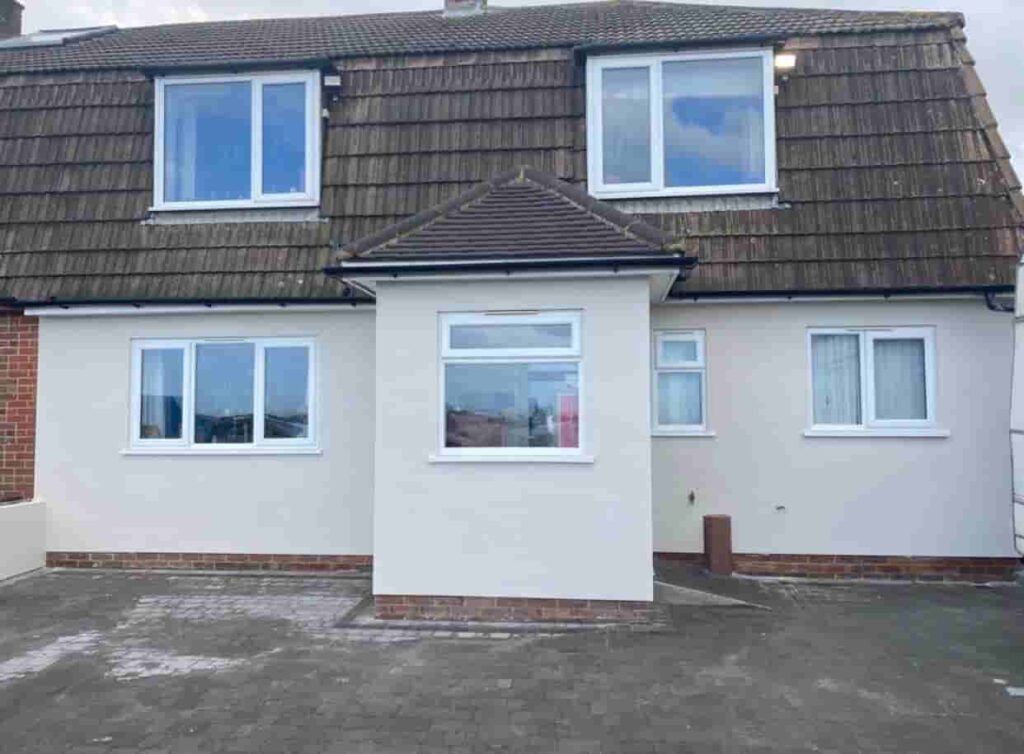
Chimneys and roof junctions are among the most vulnerable parts of a roofing system. These areas interrupt the continuous roof covering and depend on carefully fitted flashing, mortar and drainage details to direct rainwater away.
Even when the tiles or slates appear intact, a small defect at a junction can allow moisture beneath the covering. Water may then travel along underlay, battens or structural timbers before becoming visible inside the property.
Common Causes of Water Ingress Around Roof Junctions
Damaged or Loose Flashing
Flashing forms a weatherproof transition where the roof meets a chimney, wall or another raised structure. It can split, lift, distort or pull away from the masonry over time.
Once an edge becomes loose, wind-driven rain may pass behind it. The defect can be difficult to see from ground level, particularly when it is narrow or located on the rear side of a chimney.
Depending on the condition of the material, repair may involve refixing a sound section, renewing failed joints or replacing damaged flashing.
Deteriorated Mortar Joints
Flashing is often secured within joints in the chimney or adjoining wall. If the mortar becomes cracked, loose or recessed, water can enter behind the weatherproofing detail.
Surface sealants may provide only a temporary response if the underlying joint has failed. The affected mortar and flashing should be assessed together so the repair deals with both components.
Failed Soakers Beneath Tiles or Slates
Soakers are concealed pieces of weatherproofing installed beneath individual courses of tiles or slates where the roof meets a chimney or wall.
If they are missing, damaged or incorrectly positioned, water can pass through the side junction despite the visible flashing appearing satisfactory. Inspection may require nearby roof coverings to be lifted carefully so the concealed detail can be examined.
Blocked or Damaged Back Gutters
A back gutter is positioned on the upper side of a chimney to divert rainwater around the stack. Leaves, moss and debris can obstruct this channel, causing water to collect behind the chimney.
The lining may also crack, split or lose its correct fall. Clearing a blockage can restore the route, but damaged weatherproofing or surrounding materials may need separate repair.
Defective Chimney Pointing
Worn mortar between chimney bricks can allow rainwater into the masonry. Moisture may travel through the stack and appear as staining on the chimney breast or nearby ceiling.
The significance of defective pointing depends on how widespread and deep the deterioration has become. Localised repointing may be appropriate where the surrounding brickwork remains sound.
Cracked Flaunching at the Top of the Chimney
Flaunching is the mortar finish around chimney pots. It is shaped to shed rainwater and help keep the pots secure.
Cracks or separation can allow water into the chimney from above. Moisture entering at the top may appear much lower down, making it easy to mistake for a flashing defect at roof level.
Porous or Damaged Brickwork
Weathered chimney bricks can absorb significant moisture, particularly when their faces have cracked or begun to break down. Repeated saturation may create dampness even if the leadwork remains intact.
Damaged bricks and failed mortar should be inspected as part of the complete chimney structure. Treating only the junction may leave the true source unresolved.
Cracked or Displaced Roof Coverings
Tiles and slates around chimneys and junctions are often cut to fit. These smaller pieces can become cracked, displaced or poorly supported.
A covering may remain present but move enough to disturb its overlap. Water can then reach the underlay or concealed flashing beneath it. Repairs should check neighbouring materials rather than replacing only the most obvious damaged piece.
Deteriorated Roofing Underlay
Underlay provides a secondary barrier beneath tiles and slates. Around a chimney or roof junction, it must connect effectively with the surrounding drainage details.
Torn, brittle or sagging underlay can allow moisture to reach battens and timbers. If deterioration extends beyond one localised section, a wider area may need to be opened for proper assessment.
Problems Where Two Roof Slopes Meet
Valleys carry rainwater from adjoining roof slopes towards the guttering. Because they handle a concentrated flow, small defects can allow a considerable amount of water into the roof.
Common problems include:
- Accumulated leaves or moss
- Cracked valley linings
- Poorly positioned tiles
- Open mortar joints
- Restricted drainage
- Movement between adjoining roof sections
The valley and surrounding coverings should be assessed as one connected area.
Movement Between Different Materials
Chimneys and roofs contain materials that respond differently to temperature and moisture. Lead, mortar, masonry and roof coverings can expand, contract and move at different rates.
Over time, this movement may open small gaps at joints or pull flashing away from its original position. Repairs need to allow the components to perform together rather than relying on rigid surface patching alone.
Why the Visible Damp Patch Can Be Misleading
Water does not always drip directly below the defect. Once beneath the roof covering, it can travel:
- Along roofing underlay
- Across battens
- Down rafters
- Through chimney masonry
- Around insulation
- Along the top of a ceiling
The internal stain may therefore be several feet from the point where rainwater entered. Information about when the leak appears, such as during prolonged or wind-driven rain, can help narrow down the likely source.
Signs That a Junction Needs Professional Inspection
Arrange an assessment if you notice:
- Damp staining near a chimney breast
- Water marks where a roof meets a wall
- Loose or lifted flashing
- Cracked chimney mortar
- Debris collecting behind a chimney
- Repeated leaks after previous patching
- Damp timbers within the roof space
- Moisture appearing only during wind-driven rain
Avoid climbing onto the roof to investigate. Junctions are often steep, confined and difficult to access safely.
Why the Whole Junction Must Be Assessed
A lasting repair depends on identifying the actual route of the water. Replacing a tile will not resolve failed flashing, while resealing visible leadwork will not correct a blocked back gutter or porous chimney masonry.
LS Roofing Tring assesses the roof covering, concealed weatherproofing, masonry and drainage details together before recommending suitable work.
Conclusion
Water commonly enters around chimneys and roof junctions through damaged flashing, deteriorated mortar, failed soakers, blocked drainage channels or defective masonry. Movement between adjoining materials and damage beneath the visible covering can make the source difficult to identify.
If you have noticed dampness around a chimney or roof junction at your property in Tring, Hertfordshire, contact LS Roofing Tring to arrange a professional assessment. Accurate diagnosis helps ensure the repair addresses the true entry point rather than only the visible symptom.
Call us on: 01442 504 695
Click here to find out more about LS Roofing Tring
Click here to complete our contact form and see how we can help with your roofing needs.